
Why house still needs to dream.
Pads, unresolved chords and repetition long enough to stop counting — and the state they produce, which is not happiness and is not sadness and has no better name than both at once.
Dreamy House
7 min read
Behind the decks · 18 years
“Dreamy” is not a subgenre. It is a decision about what to withhold
You will not find dreamy house on a shop's genre dropdown, and that is correct. It is not a category. It is a way of building a record, and it runs straight through the labels that do exist — through balearic, through leftfield, through deep house, and now and then through something hard enough to have no business being beautiful.
What those records share is not a tempo and not a drum sound. It is a decision about what to withhold. A dreamy record declines to arrive. It sets up a harmony and does not resolve it. It builds and does not drop. It hands you an emotion without telling you which one it is.
That refusal is the entire technique. Everything below is a way of carrying it out.
The pad is the whole argument
If one element defines the sound it is the pad: a sustained chord with a slow attack and a long release, sitting under everything, doing nothing you could point at.
Its job is to remove edges. A stab tells you where the bar starts. A pad refuses to — by the time you notice it has come in it has been there a while, and when it goes you find out afterwards. It blurs the grid the drums are keeping, and a blurred grid is what lets a floor stop counting.
The common mistake is treating it as background. In this music the pad carries the emotional information and the drums only carry the time, which is the inverse of most club records. It is also why a dreamy track in the wrong room just sounds vague: it needs a system that reproduces the mids honestly and a booking that lets something sit for six minutes without a promoter getting nervous.
Repetition is the condition, not the filler
Eight bars in, a dreamy loop is monotonous. Four minutes in, it is not the same loop. You are the thing that changed.
This is the part most often mistaken for laziness. The repetition is not filler between events — it is what makes the harmony work at all. You have to stop listening for what happens next before a chord can stop being information and start being a place to stand. That takes minutes, not bars, and no amount of fills will speed it up. A dreamy record is built to be outlasted, which is exactly why it dies in a thirty-second clip and works at four in the morning.
None of which is mystical. What actually happens when a room locks into a repeated pulse is reasonably well understood, and the short version is that a body synchronises to it whether or not the person has agreed to.
Euphoria and melancholy are the same chord
The state people mean when they call this music dreamy is not happiness. It is what happens when joy turns up with a memory attached.
Harmonically that is not a metaphor. A plain major chord is closed — it tells you where it stands and it has arrived. Add a seventh or a ninth and it opens: still bright, but now leaning somewhere it never reaches. Suspend the third and you have removed the one note that decides whether the chord is major or minor at all. It stops telling you how to feel.
That ambiguity is not a trick for manufacturing an emotion. It withholds the instruction, and the listener supplies the rest — which is why the same record lands as elation one night and as grief another, on the same floor, sometimes in the same person an hour apart. Most dance music is very certain how it wants you to feel. This is the corner of it that isn't, and that uncertainty is the whole appeal.
Chasing the beauty of this world
I have called this chasing the beauty of this world for years, which sounds larger than it is meant to. It is not a claim about art. It is a description of a job: you are trying to get a room to a place that is available maybe twice a night and cannot be forced, and most of what you do is stay out of its way until it is possible.
The clearest one I have is the end of a set on the Bachstelzen floor at Fusion, somewhere between 2011 and 2014 — I have never been able to pin the year and I have stopped trying, which tells you something about the state itself. It had just got dark. Open air, a floor that had been standing there through the whole afternoon and was not going anywhere, and the sky doing the work now that the light had gone. Pure bliss, and no memory whatsoever of what was playing.
Worth saying, because the sunrise version of this story gets told so often: that was the beginning of a night, not the end of one.
It is also not nostalgia, which is the trap this kind of writing usually falls into. I have had it twice in the last year — once at Giegling, and once in Panorama Bar during a set by Richard Akingbehin that got to the same place by a different route: the same suspended, unresolved quality, but with a dub note under it, delay and space doing the job a pad does elsewhere. Beautiful, and not what I would have predicted.
That is the tell. Nobody remembers the tracklist from those moments. They remember the light and who they were standing next to. A record that does this is not trying to be memorable — it is trying to get out of the way of something else, and the ones that manage it are almost never the ones that sound impressive on headphones in a shop.
Where it belongs in a night
The stock answer is sunrise, and the stock answer is a cliché. It is not wrong — it happens — but it has hardened into shorthand for running out of ideas at seven in the morning, and it puts the credit on the sky rather than on the records.
That objection is about a habit, not about the moment, and it is taken up properly in its own guide — what daylight actually does to a room, and why in Panorama Bar somebody has to decide to let it in.
Check it against the two above and it falls apart. The Fusion one had just got dark. The Panorama Bar one was indoors, at night, with no sky involved at any point. What those have in common is not a time of day. It is a room that has already been given what it came for and will accept being somewhere instead of being moved — which can arrive an hour in, or not at all.
There is no slot for it, and looking for one is the same mistake as looking for a time of day. What decides it is not the clock. It is what the party is and what got played right before.
A night works as a relay, not as a run of separate performances, and dreamy house is the clearest case of why that is true. Dropped after a hard, straight run of pressure it reads as a stall — the room has not been asked to arrive anywhere, so it has nothing to accept. Set up by a record that has already pulled the energy back and left a few bars breathing, it reads as exactly where the night was always going.
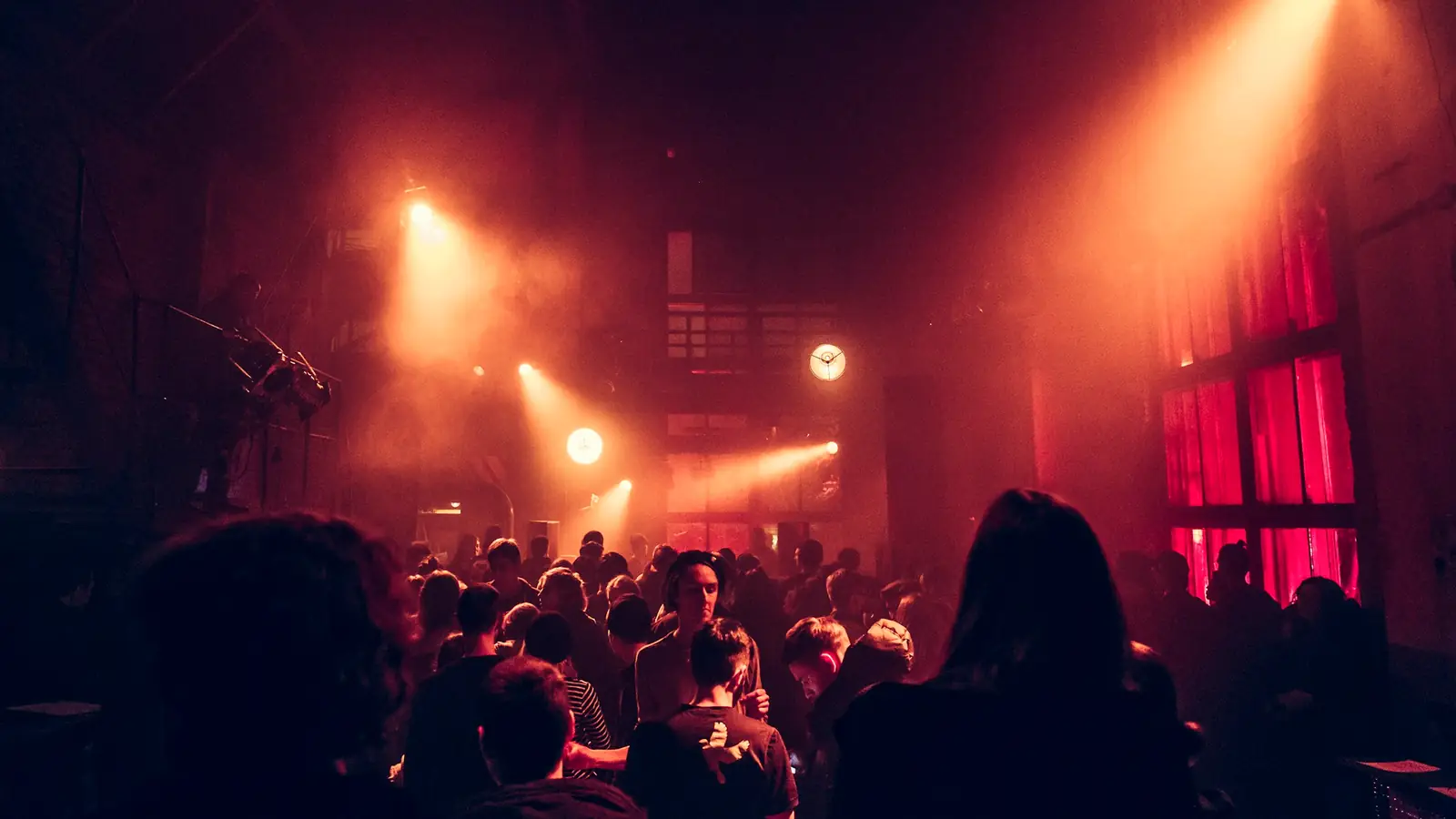
The party matters as much as the handover. A night built entirely around peaks has no room for this at any hour of it. A night built around a state — the kind Giegling can be, or a Panorama Bar booking with the right resident on — can hold it in the middle and lose nothing. Fusion and Panorama Bar happened at genuinely different hours for exactly this reason: not a formula, but what everything around them had already set up.
Where it does fail reliably is as a rescue — dropped in because the room has gone flat and something needs to happen. That asks repetition to do a peak's job, and repetition cannot do that job. It only works once it has already been earned.
Where this sits in the Hybrid Flight sound
Hybrid Flight works under the claim Emotional Dancefloor Atmosphere, which is this territory described from the other side — mood before genre, sets assembled as an arc rather than a run of tracks. In the labels the project actually uses it sits closest to balearic and leftfield house, though as above, dreamy is not the eighth genre on the list. It is a mode the others get played in.
Practically that means the tempo moves across a set and the mood does not. It also means the long-form mixes are the honest format — the recorded work and the mixes are here, and the Between Coasts EP was written between Andalusia, Ibiza and Berlin, which is roughly the geography of the sound.
And the city question — whether any of this survives contact with a place known for something much harder — is its own guide, as is why the same record plays differently five hours into a night, and a deep house mix for the quieter end of a Berlin night, and why balearic is not a genre covers the selection side of the same instinct, and Ibiza before the drop the island it came from. An underground mix takes the opposite case: a set with no room to answer to at all, and the booking guide covers what a promoter is actually choosing, and the blue hour as a technique is the other end of the light question. The Codex is where the arguments behind all of it are made at length.
What is dreamy house music?
Not a subgenre — a way of building a record, running through balearic, leftfield and deep house alike. What the tracks share is a refusal to arrive: a harmony that is set up and not resolved, a build with no drop, an emotion handed over without a label attached.
What makes a house track sound dreamy?
Mainly the pad: a sustained chord with a slow attack and long release that blurs the grid the drums are keeping. In this music the pad carries the emotional information and the drums only carry the time, which is the inverse of most club records.
Why is repetition so important in dreamy house?
Because a chord cannot stop being information and start being a place to stand until you have stopped listening for the next event. That takes minutes rather than bars and cannot be hurried with fills — which is why the music dies in a thirty-second clip and works at four in the morning.
Why does euphoric dance music often feel sad at the same time?
Because of what the harmony withholds. A plain major chord has arrived; add a seventh or a ninth and it leans somewhere it never reaches, and suspend the third and you have removed the note that decides major or minor at all. The chord stops telling you how to feel, so the listener supplies the rest.
Is dreamy house the same as deep house or balearic house?
No. Deep house and balearic house are genres with their own drum and production conventions; dreamy is a mode those genres can be played in, and so can others. A record can be balearic and not dreamy, or dreamy and much harder than either label suggests.
When do you play dreamy house in a DJ set?
There is no fixed slot, and sunrise is the cliché version of looking for one. What actually decides it is the party and the handover — what got played right before. Set up by a record that has already pulled back and left room to breathe, it can work at any hour, including the middle of a night built around a state rather than a peak. Dropped in cold as a rescue, it fails reliably, because that asks repetition to do a peak's job.
The long version, with no talking.
Emotional Dancefloor Atmosphere is a mix built as an arc rather than a playlist — mood before genre, with an unreleased demo somewhere in the middle. Everything above is easier to hear than to read.
The arguments this comes out of.
The positions this project works from — on DJ craft, club culture and the industry built around them.
Why a Room Dances Together
The feeling of a room becoming one thing is not an effect of the lights or the volume. It is the oldest social technology we have, working exactly as designed.
Better Than You Think
"If you're an artist, remember that in 2026 there's not a single part of the system that isn't faked. You're probably doing better than you think."
Two Brushstrokes
His image: a painting nobody can see, on a platform where two brushstrokes fit — and the whole canvas hangs somewhere else, on a site nobody visits.