
Balearic isn't a genre. That's the point.
Where the word came from, why the people who built it refuse to call it a style, how it got flattened into sunset chillout, and what actually holds a balearic set together once tempo and era stop being the rule.
Balearic
8 min read
Behind the decks · 18 years
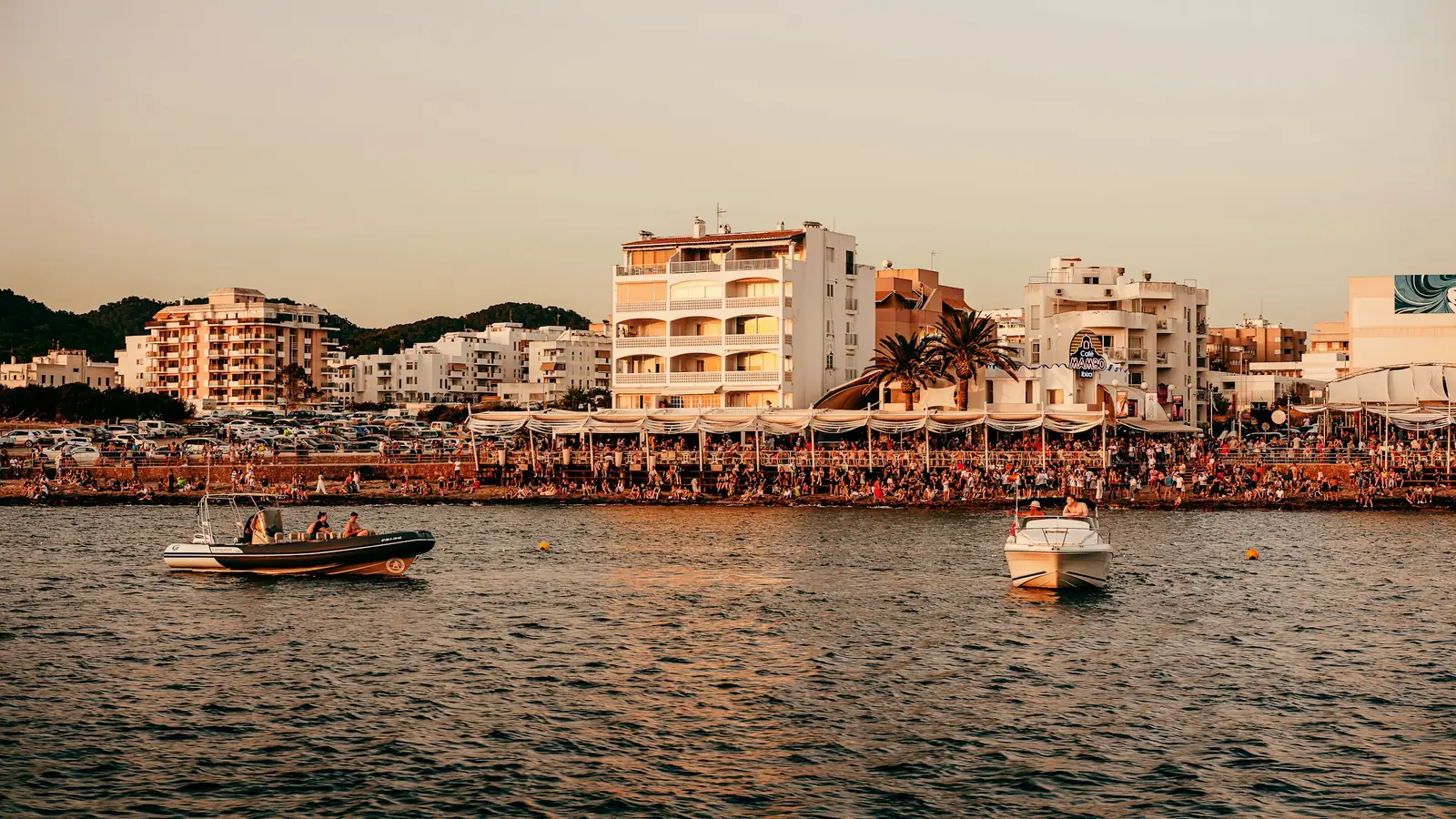
Why every definition of the sound falls apart
Every few years somebody sets out to write down what balearic sounds like. The attempts fail, and they fail in the same direction each time: whatever gets nominated as essential — the tempo, the warmth, the guitar, the sense of open air — has an obvious counterexample sitting in the same record box, and usually in the same set.
That is not a gap in the research. It is the finding. The word was never describing a sound, and it admits as much in its own name: it points at an archipelago, which is to say at a location and a set of circumstances, rather than at anything you could isolate inside a studio.
The circumstances were specific. Amnesia, in Ibiza, where Alfredo Fiorito — an Argentine who had come to the island in the seventies — was playing from 1983 onwards. What went through that room was disco next to rock, jazz next to synth pop, Italo next to soul, reggae, new wave, and, once it started arriving from Chicago, house.
Read that as a list of styles and it is incoherent. Read it as a list of decisions and it resolves at once: every record was in there because it worked in that room at that hour, and nothing else qualified it. The criterion held constant. The material was free to vary, and did.
When the British DJs turned up at the end of the decade — Rampling, Oakenfold, Holloway, Walker among them — what they carried home was not a crate. It was that criterion, and within about a year it was inside what Britain started calling acid house.
It was never a sound. It was a way of choosing
This is the part that survives worst in writing, and it is worth being clear that it is not an interpretation of mine. The people who built it have been repeating it for thirty years — not a genre, an open-minded approach to what you play — and it keeps getting transcribed as a style anyway, because a style is easier to file.
The distinction is not pedantry, because the two are not even the same kind of fact. A genre is a property of a record. It sits in the file, it travels with the file, and you can hear it without knowing anything else about the night. Balearic is a property of a decision, and decisions exist in sequence. Lift the record out of the set and the quality you were pointing at is no longer in your hand.
Which produces the consequence people find most irritating: the same track can be balearic on Friday and not on Saturday. Nothing about it changed. What changed is what came before it. That reads like an evasion and is not one — it is a definition that happens to live in the join rather than in the object, and there is no rule requiring definitions to sit inside files.
It also moves what failure means. You cannot play a wrong record here, because no record is disqualified in advance. You can only play one that does not fit what is actually happening in front of you, which is a far harder standard to meet and one a room detects immediately.
Then it was sold back as a mood
By the late nineties the word had been packaged and handed back to everyone as an atmosphere: a terrace, a sunset, something downtempo, a compilation with an orange sky on the sleeve. For a great many people that is still the entire meaning of it.
The music was never the problem. Café del Mar existed, José Padilla was a real selector, and holding a room while the light goes is a discipline with its own difficulty — arguably a steeper one than peak time, because nothing in the room is helping you.
The problem is what the packaging did to the idea. It took a method whose entire content was a refusal to be categorised and made it a category — one tempo, one hour of the day, one emotion held flat for the length of a CD. That is not a simplification of the thing. It is its inverse, sold under its name.
The correction is geographical and it takes one sentence. Amnesia is inland. The music that gave the word its meaning was happening in a dark room, at night, at peak time, several kilometres from any view at all — and it contained records a peak-time set is not supposed to contain. The terrace came afterwards, and it came second.
What actually holds a balearic set together
If style is not the criterion, something else is carrying the weight. Four things do, and not one of them is a property you could tag a file with.
Air in the arrangement. Not quiet, and not sparse for its own sake — unfilled. A record with every band occupied has already decided what the room is going to hear, and it cannot sit beside something from another decade without one of the two being audibly wrong. Space is what lets two unrelated records share a room without either of them having to win.
Warmth where most club music applies pressure. The bulk of dance music is engineered to push: it works by building force and releasing it. A great deal of this works by holding instead. The difference shows up in what a floor does — moved, against willing to stay — and the second state is what lets a set change direction without the room reading it as energy lost.
Tempo permitted to move. A set here can travel eight or ten BPM across an hour without breaking, because tempo was never what was holding it together. Mood was, and mood tolerates a change of speed that a straight club set would register as a mistake. It is also why the transitions can run long: nothing depends on the grid staying put.
Indifference to release date. A twelve from 1983 and something pressed last month face the same question and neither gets an advantage from the answer. Very few ways of DJing are genuinely free of this — most are organised, quietly, around what is current. This one cannot be, because currency was never part of the test.
Together they account for the thing people find hardest to accept: you cannot identify a balearic record by listening to it alone. The property is not in the record. It is in what you put beside it.
Where this sits in the Hybrid Flight sound
Hybrid Flight lists balearic house among the genres the project actually works in, and it is the one that does the most explaining. Sets here are built as an arc rather than a run of tracks, tempo moves inside them, and mood is the thing held constant — which is the method above, described from the inside.
The Between Coasts EP was written between Andalusia, Ibiza and Berlin, and the geography is not decoration. It is a record about the distance between a Mediterranean afternoon and a Berlin club at four in the morning — which is the same distance this word has been asked to cover since 1983. Balearic Bliss came off those sessions and was released on its own.
YouTube is blocked until you allow external media.
Privacy detailsThe neighbouring arguments have their own guides: why house still needs to dream takes the harmonic side of this — pads and chords that decline to resolve — and house music in Berlin deals with what happens when an open-ended way of playing is carried into a city with a reputation for the opposite. Late night and a deep house mix cover the hours at the far end of the same night. Ibiza before the drop takes the island itself — the season, the residencies, and why the drop became the export — while an underground mix asks what is left of a selection when nothing depends on it, and one more is written for the people doing the booking. The two ends of a night have guides of their own — what daylight does to a floor and the blue hour as a technique. The Codex is where the arguments behind all of it get made at length.
What does balearic mean in music?
It is named after the Balearic Islands, and specifically after what DJ Alfredo played at Amnesia in Ibiza from 1983 onwards: disco, rock, jazz, soul, synth pop, Italo and early house in the same set. It describes an approach to choosing records rather than a style of record, which is why the people who built it consistently refuse to call it a genre.
Is balearic a genre?
No, and the DJs who made it say so before anyone else does. A genre tells you what a record sounds like; balearic tells you how a record got chosen. The practical consequence is that the same track can be balearic in one set and not in another, because what makes it balearic is what sits either side of it.
What is the difference between balearic and chillout?
Chillout is a mood sold as a category — downtempo, sunset, one emotion held for an hour. Balearic is a method defined by refusing categories. The music that named it was peak-time club music at a nightclub, not terrace music at eight in the evening. Chillout is one subset of it that got sold as the whole thing.
What makes a track balearic?
Nothing you can hear in isolation, which frustrates anyone looking for a checklist. In practice the records that work leave air in the arrangement, carry warmth rather than pressure, and survive being played next to something from a different decade and a different genre. That last one is the actual test.
Where did balearic music come from?
Ibiza in the mid-eighties, at Amnesia, where Alfredo Fiorito had been resident since 1983. British DJs including Danny Rampling, Paul Oakenfold, Nicky Holloway and Johnny Walker visited in the late eighties and took the approach back to the UK, where it fed straight into acid house.
Is balearic house the same as Ibiza house?
The terms get used interchangeably and neither is precise. Ibiza house now mostly names what the island's large commercial clubs export, which is close to the opposite of the open-ended selection the word originally described. Balearic house is the older sense: house records chosen the way Alfredo chose everything else.
Written between two coasts.
Between Coasts is five tracks moving between Andalusian afternoons, Mediterranean sunsets and the late-night end of a Berlin club — which is the argument above, made in the format where it actually belongs.