
Why a Room Dances Together
The feeling of a room becoming one thing is not an effect of the lights or the volume. It is the oldest social technology we have, working exactly as designed.
Essay
6 min read
#club culture #dance floor #djing
There is a moment, usually somewhere in the second hour, when a room stops being a few hundred separate people and becomes one thing. Nobody announces it and nobody organised it. Everyone is simply on the same beat, and the temperature of the room changes.
Most writing about clubs treats that as atmosphere — a nice way of describing lights, volume and chemistry. It is considerably more concrete than that. There is a decent body of research on what happens when humans move in time together, and almost all of it says the same thing: this is not a side effect of the party. It is the point of it, and it works on everybody.
Almost nothing else can do this
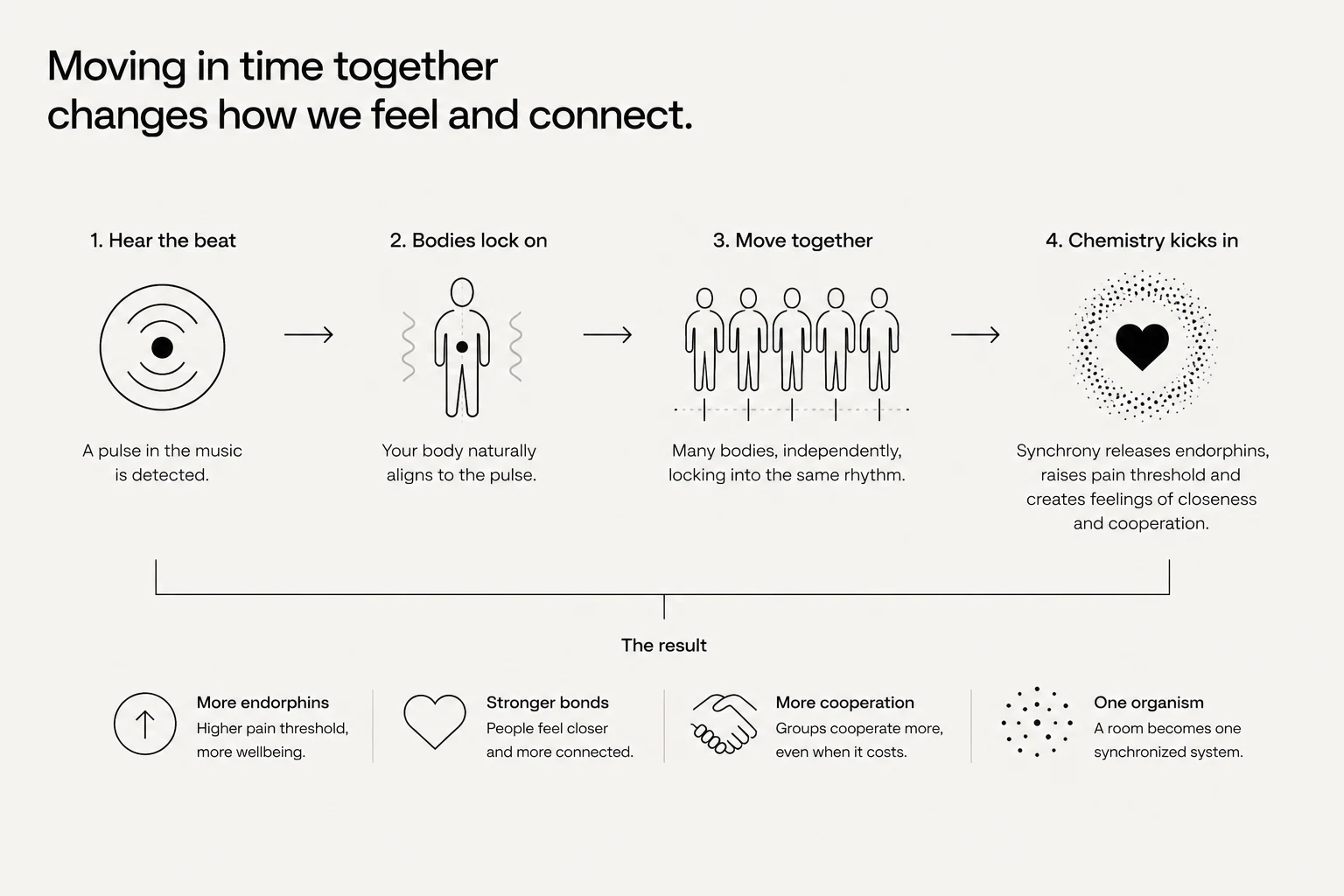
Start with the part that is easy to take for granted. You hear a pulse and your body finds it, without effort, without training and usually without noticing.
That ability is close to unique. Spontaneous synchronisation to a musical beat is universal in humans and absent in most other species — including dogs, who have spent thousands of years within earshot of human music and have never once nodded along. The leading explanation ties it to vocal learning: the same tight coupling between hearing and motor control that lets us imitate sounds may be what lets us lock onto a pulse.
The picture has filled in a little since. Some parrots do it. A sea lion does it, convincingly. And in 2022 a team demonstrated it in rats, who synchronised most strongly somewhere between 120 and 140 beats per minute — which is, with no irony available to me at all, the tempo range of most of the music discussed on this site.
So the club is not doing anything exotic. It is running a very old piece of human hardware at high volume, in the dark, with better speakers than usual.
What moving in time actually does
The most useful study here came out of Oxford in 2015. Bronwyn Tarr, Jacques Launay, Emma Cohen and Robin Dunbar took 264 Brazilian high-school students and had them dance in small groups, varying two things independently: how synchronised the movement was, and how physically demanding.
They measured pain threshold before and after, which is a standard proxy for endorphin release, and asked about social closeness.
Both variables did something on their own. Exertion helped — no surprise. But synchrony helped separately: the groups moving in time with each other showed raised pain thresholds and reported feeling more bonded, while the groups doing equally hard work out of time showed no such effect.
Read that again, because it is the whole argument. Dancing hard is one thing. Dancing together is a different thing, and the body can tell the difference.
This lines up with earlier work by Wiltermuth and Heath, who found across three experiments that people who had acted in synchrony — walking in step, singing together — cooperated more afterwards, including when cooperating cost them something. Their participants did not need to be in a good mood for it to work. The synchrony did the job by itself.
Why the gaps are the invitation
There is a second piece of research that anyone making this music should have read, because it explains something producers otherwise learn slowly and by accident.
In 2014 Maria Witek and colleagues had people rate funk drum breaks of varying rhythmic complexity on two axes: how much pleasure they felt, and how much they wanted to move. The result was an inverted U. Rhythms with a medium degree of syncopation produced by far the strongest desire to move and the most pleasure. Perfectly regular patterns produced less. Extremely complex patterns produced less as well.
The interpretation is lovely. When a rhythm leaves a well-placed gap, some part of the listener fills it in — the body supplies the missing beat. Too regular and there is nothing to supply. Too irregular and there is no pattern stable enough to predict. Somewhere in between, the music leaves exactly enough room for a person to complete it, and completing it feels good enough that they will do it for six hours.
Which reframes what a groove even is. Not a command to move. An unfinished pattern, offered to a room full of people who cannot help themselves.
What that means from behind the decks
All of this is unusually practical, and it is most of what I think the job is.
If synchrony is where the effect lives, then everything that helps a room stay locked matters more than anything that shows off: stable tempo, clean transitions that do not break the pulse, and resisting the urge to change direction just because I am bored — I have heard the record five hundred times, they have heard it once.
If medium syncopation is the sweet spot, then the pocket is a real place and it is worth spending a long time finding. In production it means leaving space rather than filling it. On a floor it means noticing when the room has locked in and then mostly getting out of the way, because the thing that is happening is happening between the people in it.
And if bonding comes from time spent in synchrony, then length is not self-indulgence — it is dosage. The good part comes late because it takes a while for several hundred strangers to arrive at the same place.
Marie Davidson put the arc better than I can in an interview earlier this year: a set needs a takeoff, a flight and a landing. Given the name over the door here, I am not going to pretend I can improve on that.
The word for it
Durkheim got there in 1912, long before anyone could measure a pain threshold. He called it collective effervescence: the state a group enters when it does something rhythmic together, in which the individual briefly stops being the unit of experience. He was writing about ritual. He might as well have been describing four in the morning.
That is the part worth holding onto, and it is the reason none of this is sentimental. The feeling of a floor becoming one organism is not produced by the lights, the volume, the drinks or the mythology. Those help. But the mechanism underneath is ancient, it is shared by every person in the room whether or not they know anything about the music, and it is the same mechanism that has been holding human groups together for as long as there have been groups.
We are just running it at 124 BPM, with a very good sound system, and calling it a Saturday.
Sources: Tarr, Launay, Cohen and Dunbar, Synchrony and exertion during dance independently raise pain threshold and encourage social bonding (Biology Letters, 2015); Wiltermuth and Heath, Synchrony and Cooperation (Psychological Science, 2009); Witek, Clarke, Wallentin, Kringelbach and Vuust, Syncopation, Body-Movement and Pleasure in Groove Music (PLoS ONE, 2014); Ito and colleagues on spontaneous beat synchronisation in rats (Science Advances, 2022); Émile Durkheim, The Elementary Forms of Religious Life (1912). The Marie Davidson quotation is from her interview with Electronic Groove, May 2026.
Why do people dance together in clubs?
Because moving in time with other people has measurable effects that moving alone does not. Oxford research found that dancing in synchrony raised participants' pain thresholds — a standard proxy for endorphin release — and increased their reported social closeness, independently of how hard they were exerting themselves.
Is synchronising to a musical beat unique to humans?
Close to it, though not entirely. Spontaneous beat synchronisation is a human universal and absent in most species, including dogs, who have lived alongside human music for millennia. It has since been documented in some parrots, a sea lion, and — in a 2022 study — in rats, who synchronised most strongly between roughly 120 and 140 beats per minute.
Why does syncopation make you want to move?
Because the body appears to complete the pattern. A 2014 study by Witek and colleagues found an inverted-U relationship: rhythms with a medium degree of syncopation produced the strongest desire to move and the most pleasure, while very simple and very complex rhythms produced less of both. The gaps are the invitation.